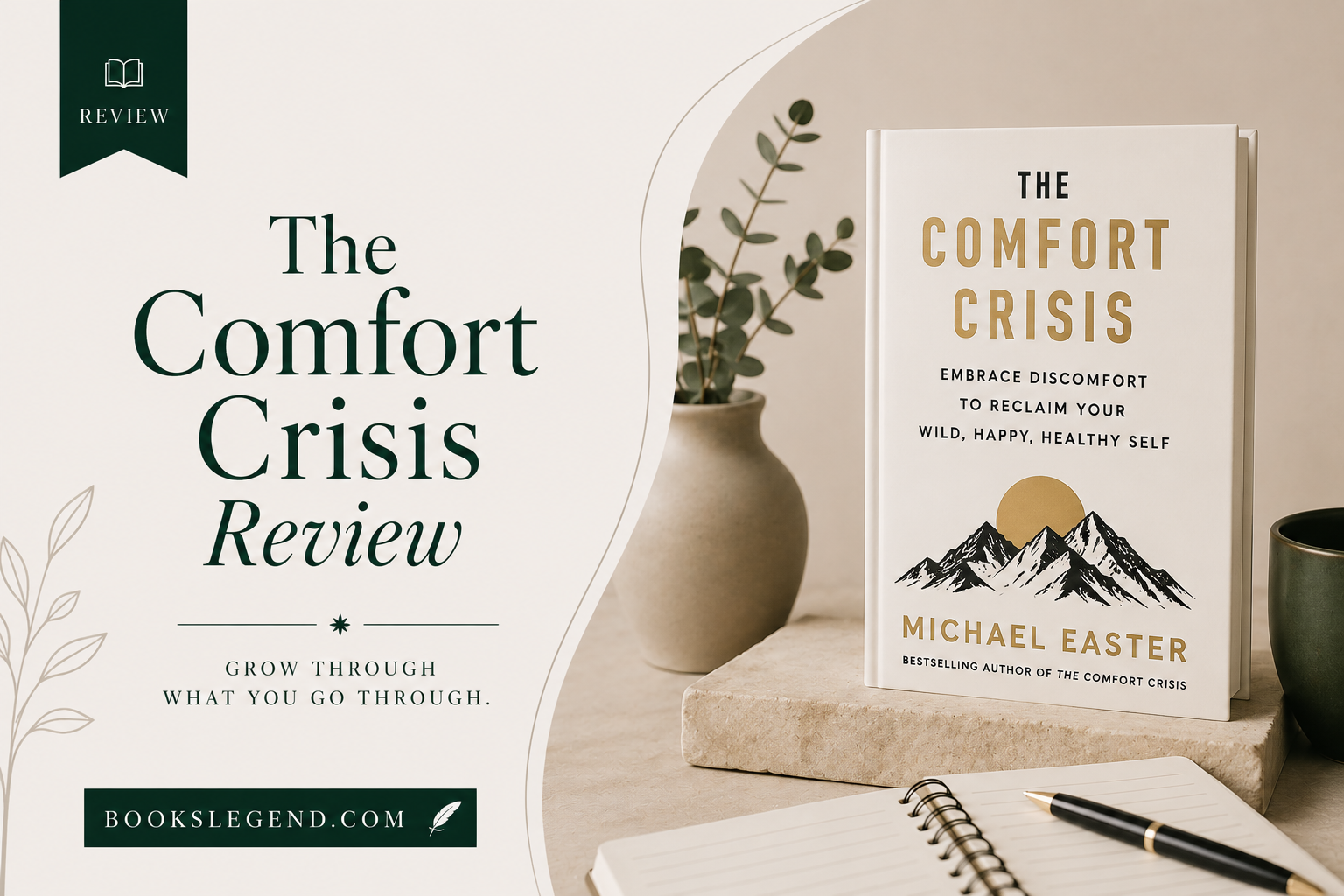
The Comfort Crisis Review: Is Michael Easter’s Book Worth Reading?
The Comfort Crisis review has been on readers’ radar ever since this book hit shelves in 2021. And for good reason. Michael Easter wrote something that feels less like a self-help book and more like a punch in the face, the kind that wakes you up.
In the best way possible.
What Is The Comfort Crisis About?
The book’s full title is The Comfort Crisis: Embrace Discomfort to Reclaim Your Wild, Happy, Healthy Self. That title says it all.

Easter’s core argument is simple: modern life has made us too comfortable. We sit on padded chairs, eat whenever we want, avoid silence, and scroll through our phones to dodge any moment of boredom. And all of this ease, Easter argues, is quietly destroying our mental and physical health.
To explore this idea, he spent 33 days in the remote Alaskan backcountry on a caribou hunting expedition. No phone signal. No warm showers. Just wilderness, weather, and his own thoughts. He weaves this journey through the book alongside interviews with scientists, psychologists, and athletes.
The result is part adventure story, part science lesson, and part life challenge.
Who Is Michael Easter?
Easter is not just some guy who went camping and wrote a book about it.
He is a professor at the University of Nevada, Las Vegas (UNLV) and has written for Men’s Health, Outside magazine, Vice, Scientific American, and Esquire. The Comfort Crisis became a New York Times bestseller, and he followed it up with another book called Scarcity Brain.
He also narrates the audiobook himself, which adds a personal touch that works really well.
His background in journalism shows throughout the writing. Easter knows how to take dense research and make it feel like a conversation. That skill alone separates this book from most wellness titles.
The Comfort Crisis Review: What Works
A lot, actually.
First, the structure is smart. Easter does not just lecture you about why comfort is bad. He takes you with him into the wilderness, then cuts away to explain the science behind what he is experiencing. That rhythm keeps things moving and stops the book from feeling like a lecture.
Second, the ideas are genuinely useful. He covers a wide range of topics: exercise, nutrition, hunger, boredom, solitude, cold exposure, and rucking. Each one is backed by research, but Easter keeps the explanations short and readable. You do not need a science degree to follow along.
Third, the book is honest. Easter includes perspectives from people who disagree with parts of his thesis. He traveled to Bhutan to explore how people measure happiness beyond material gain. He interviewed economists, neuroscientists, and sports scientists. That level of reporting gives the book real credibility.
The Comfort Crisis Review Highlights: Key Ideas That Stick
A few ideas from this book are the kind you think about weeks later.
The moving goalposts problem. Easter explains how modern life keeps shifting what we consider a problem. Things that would have been meaningless inconveniences to our ancestors now feel like catastrophes. This concept, connected to “first world problems,” is not just funny, it is a genuine mental health issue.
Rucking. Easter popularized the practice of rucking, which is simply walking with a weighted backpack. It sounds boring. It works incredibly well. After this chapter, many readers immediately ordered a rucking pack, and for good reason. The research Easter presents is convincing.
Hunger is not the enemy. One of the most quietly powerful chapters deals with eating. Easter cites research showing that real hunger drives only about 20 percent of modern eating. The rest is boredom, stress, or habit. That number hits hard if you let it sink in.
Solitude matters. Easter makes a strong case that the average person is terrified of silence. We fill every quiet moment with podcasts, music, or scrolling. But research shows that mental rest, real mental rest, is necessary for creativity and emotional health.

The Misogi Concept Explained
This is one of the most original ideas in the book, and it deserves its own section.
Easter introduces readers to the concept of Misogi, which comes from Japanese tradition. A Misogi is a personal challenge that meets two specific criteria. First, it must be something you might fail. There should be roughly a 50/50 chance of success. Second, it must be done for yourself, not to post about on social media.
Easter’s Misogi was the 33-day hunting trip. For someone else, it might be running a marathon, learning to swim at 50, or hiking a mountain with no prior training.
The point is not what the challenge is. The point is that completing something genuinely hard, something where failure was possible, reshapes how you see yourself. It pushes your limits in a way that easier challenges never will.
This idea has been picked up by MLB teams, NCAA programs, and universities, according to research cited in the book. It is not just a feel-good concept. There is real evidence that these kinds of challenges build lasting mental toughness.
What the Science Says
Easter is not making things up. The science in this book is solid, and he cites his sources clearly.
A few standout data points from the book:
People sleep-deprived to just five hours eat, on average, 550 more calories per day than those who sleep eight hours. That is not a small difference. That is a whole extra meal.
Research from the University of North Carolina found that people snack 75 percent more than they did before 1978, with snacks that are 60 percent larger and more likely to be ultra-processed.
Cold exposure, which includes cold showers and ice baths, may improve circulation and mental fortitude by mimicking stressors our ancestors faced daily. This ties into a concept called hormesis, the idea that small doses of stress make the body and mind stronger over time.
These are not vague claims. Easter pairs them with real studies, real experts, and real-world examples. That rigor makes the book much more persuasive than the typical wellness title.
What Does Not Work as Well
No honest review skips the downsides, so here are a few things to keep in mind.
The hunting focus is polarizing. A big chunk of the Arctic narrative involves caribou hunting. For readers who are uncomfortable with hunting, this may be hard to get past. Easter does not dwell on it in a graphic way, but it is a real part of the story.
Some ideas feel familiar. If you have already read widely in the health and wellness space, parts of this book may cover ground you have seen before. The obesity epidemic, the benefits of nature, the problem with screens, these topics are well-trodden. Easter adds depth, but do not expect to be surprised on every page.
The adventure format does not suit everyone. Some readers want a straightforward guide. Easter’s hybrid approach of memoir plus science works beautifully for most readers, but if you prefer bullet-point advice, the narrative style might feel slow.
These are minor criticisms of a genuinely strong book.
Who Should Read The Comfort Crisis?
This book is for anyone who has noticed that life feels a little off, even when things look fine on paper. Good job, comfortable home, food in the fridge, and yet still restless, anxious, or flat.
It is especially useful for people who:
- Feel stuck in routine and want a real reason to change
- Are curious about fitness but want the “why” behind the advice
- Struggle with anxiety or low energy and want science-backed ideas
- Like books that combine storytelling with research (think Born to Run or Atomic Habits)
It is not a gentle read. Easter wants you to be uncomfortable, and the book itself pushes on you a little. That is by design.

Final Verdict
This Comfort Crisis review lands on a clear conclusion: read this book.
It is one of those rare titles that gives you both a good story and practical tools you can use starting tomorrow. Easter is a skilled writer who respects his readers enough to show his work. The ideas are strong, the research is solid, and the Arctic adventure narrative keeps things from ever feeling dry.
Is it perfect? No. The hunting narrative will put off some readers, and parts of the science section cover familiar territory for wellness enthusiasts. But the core argument, that we have made ourselves too comfortable and it is costing us our health, our resilience, and our joy, is one worth sitting with.
Pick it up. Then go outside and do something hard.
Tags: