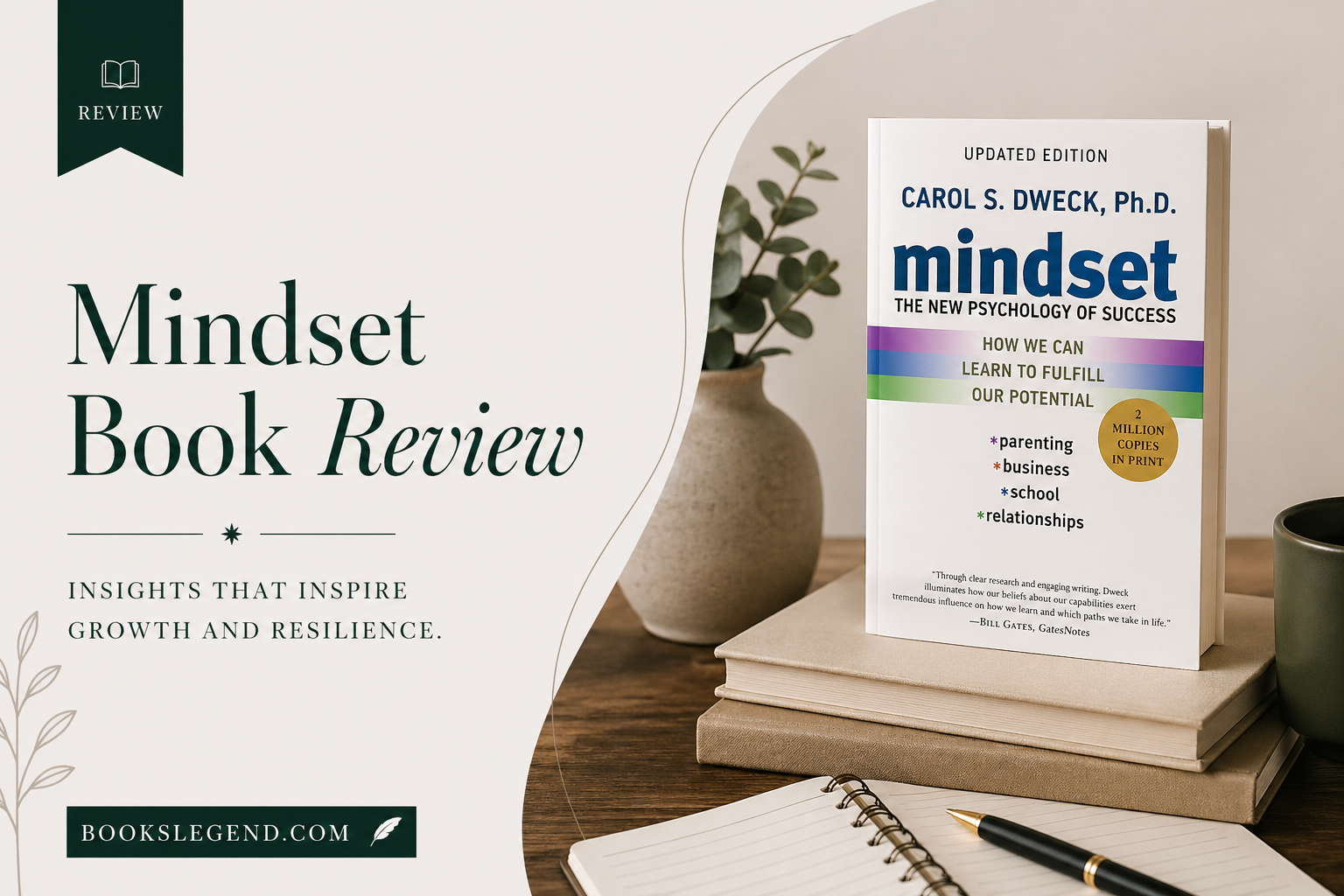
Mindset Book Review: What Carol Dweck’s Research Really Teaches You
This Mindset book review covers one of the most talked-about psychology books of the last two decades. Carol Dweck’s Mindset: The New Psychology of Success has influenced schools, sports teams, businesses, and millions of readers worldwide. But does it hold up? And more importantly, can it actually change how you think?
Let’s find out.
What Is the Book About?
Mindset was published in 2006. It is based on decades of research by Stanford psychologist Carol Dweck. The central argument is simple: the way you think about your own abilities shapes almost everything in your life.
Dweck says there are two types of mindsets. A fixed mindset means you believe your intelligence and talents are set in stone. A growth mindset means you believe you can develop your abilities through effort, good strategies, and help from others.
That sounds straightforward. But the way Dweck unpacks it across hundreds of real examples is what makes the book worth reading.

Meet the Author: Carol Dweck
Carol Dweck is a professor of psychology at Stanford University. She has spent more than 30 years studying motivation and achievement. Her research has been published in journals like Science and Developmental Psychology, and she has received numerous awards for her contributions to education and psychology.
You can learn more about her work directly on the Stanford University faculty page.
She is not writing from a self-help background. She is a researcher. That distinction matters because it means her claims in Mindset come from actual studies, not just personal experience or anecdote.
The Core Idea: Fixed vs. Growth Mindset
The fixed vs. growth mindset concept is what most people know Dweck for. But the book goes much deeper than a simple label.
How a Fixed Mindset Holds You Back
People with a fixed mindset tend to avoid challenges. Why? Because if you fail, it feels like proof that you are not smart or talented. Criticism feels like an attack. Effort feels pointless if you believe talent is either there or it is not.
Dweck shares research showing that children who were praised for being “smart” after a test were more likely to choose easier tasks next time. They wanted to protect the label. Kids praised for effort chose harder tasks because they saw challenge as the point.
That finding is quietly devastating when you think about it. The way we praise kids changes how they respond to difficulty years later.
How a Growth Mindset Opens Doors
A growth mindset shifts your focus from proving yourself to improving yourself. Failures become data. Criticism becomes coaching. Hard work is not a sign that you lack talent; it is the path to developing it.
Dweck draws on examples from sports (Michael Jordan, for one), business (leaders at IBM and Enron), and education to show how the two mindsets play out in real life.
The Mindset Book Review Debate: Is It Too Simple?
Some critics argue the fixed vs. growth framework oversimplifies human psychology. And honestly, they have a point worth hearing. Mindset is not an on-off switch. Most people sit somewhere in the middle, and that can shift depending on the subject or situation.
Dweck does acknowledge this in the book, though not as loudly as some readers would like. The nuance is there, but you have to look for it.
What the Mindset Book Review Reveals About Its Strengths
There is a reason this book has sold millions of copies. It earns its reputation in several real ways.
It Is Grounded in Real Research
Unlike a lot of popular psychology books, Mindset is not built on a handful of case studies or borrowed ideas. Dweck spent decades studying motivation in children, students, and adults. The patterns she describes are consistent across different contexts.

That gives the book a kind of quiet authority. You feel like you are reading someone who has genuinely earned their conclusions.
The Examples Feel Real
Dweck uses stories from sports, business, relationships, and parenting to bring abstract ideas to life. The section on relationships alone is worth the price of the book. She explains how couples with fixed mindsets expect relationships to just “work” naturally, while growth-mindset couples treat problems as something to work through together.
That reframe is small but powerful.
It Is Practical Without Being Preachy
The book ends with guidance on how to shift toward a growth mindset. Dweck is careful not to make it sound easy or instant. She acknowledges that fixed mindset thinking is deeply ingrained in most people, and that changing it takes real effort.
That honesty makes the practical advice feel more trustworthy. She is not selling a quick fix.
Where the Book Falls Short
No book review worth reading skips the criticism. Mindset has real weaknesses.
It Can Feel Repetitive
The core idea is introduced early and clearly. But Dweck returns to it again and again across different domains. By the third or fourth time you encounter the same basic contrast, some readers start to skim.
A tighter edit would have made this a leaner, sharper book. At around 300 pages, it runs about 50 pages too long for the density of new ideas.
The Research Has Faced Scrutiny
In recent years, some of Dweck’s research findings on growth mindset interventions in schools have been difficult to replicate. Several large-scale studies trying to reproduce the effects in classrooms found mixed or weak results.
Dweck has responded to this, and the debate is still ongoing. For most readers, this will not undermine the book’s core message. But it is worth knowing that the science is not as settled as the book sometimes implies.
The Business Section Is the Weakest
The chapters on corporate culture and leadership feel less grounded than the education and sports sections. The analysis of companies like Enron as examples of fixed mindset culture is interesting, but it can feel like retrofitting a theory to a story.
That said, it does not derail the book. It just feels thinner.
Who Should Read Mindset?
This book is a strong choice for:
- Parents who want to support children’s confidence in learning without accidentally teaching them to fear failure
- Teachers and coaches looking for a framework to understand why some students or athletes shut down under pressure
- Anyone who has ever felt like they were “just not good at” something and wondered whether that belief was true or learned
- Managers and team leaders who want to build cultures where people are willing to take risks and learn from mistakes
It is also a quick read. Most people finish it in a few days.
If you have already read books like Grit by Angela Duckworth or Atomic Habits by James Clear, you will find that Mindset covers some overlapping territory. But it comes at the ideas from a different angle, and the research base is distinct.

Key Takeaways You Can Use Today
You do not need to read the whole book to start applying its ideas. Here are the most useful things to carry with you.
Praise Effort, Not Talent
When you compliment someone (especially a child), focus on what they did, not what they are. “You worked really hard on that” teaches something different than “You’re so smart.” This is one of the most actionable findings in the book.
Treat Challenges as Practice
A fixed mindset says: if it is hard, I am probably not good enough. A growth mindset says: if it is hard, that means I am learning something. The next time something frustrates you, try asking “What is this teaching me?” instead of “What does this say about me?”
Notice Your Fixed Mindset Triggers
Dweck encourages readers to identify the situations that pull them into fixed mindset thinking. For some people, it is public failure. For others, it is criticism from someone they respect. Knowing your triggers is the first step to responding differently.
Final Verdict
This Mindset book review comes to a clear conclusion: read it. Not because it will transform your life overnight, but because it offers a genuinely useful lens for understanding your own reactions to challenge, failure, and growth.
Dweck writes with clarity and warmth. The research is solid, even if some of the more ambitious claims about schools have faced pushback. And the core insight, that how you think about your own abilities shapes how you approach everything, holds up across every domain she explores.
It is one of those rare books that changes a few words in your internal vocabulary and then, slowly, changes how you see things.
For a well-rounded reading experience, you might also want to check out Goodreads reviews of Mindset to see how other readers responded to the book across different life stages.
Rating: 4 out of 5 stars
Tags: