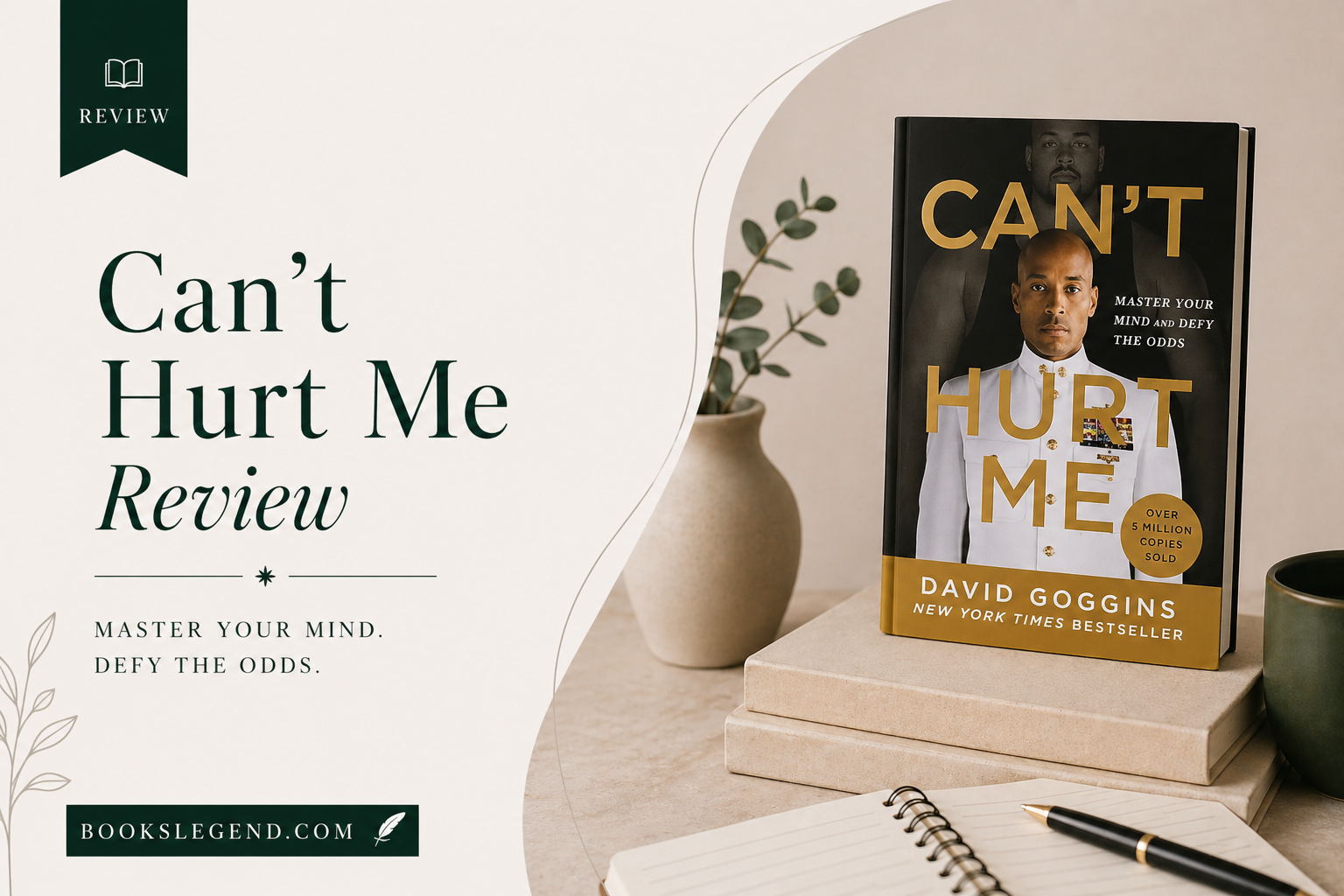
Can’t Hurt Me Review: The Raw, Unfiltered Book That Will Change How You Think About Limits
This Can’t Hurt Me review is for anyone who has ever wondered what it really takes to push past the point where most people quit. David Goggins doesn’t write like most authors. He doesn’t wrap his lessons in polished language or tidy inspiration. He hits hard, and he means it.
What Is Can’t Hurt Me About?
Can’t Hurt Me is part memoir, part self-help, and part challenge. Goggins tells the story of his life, and it is brutal. He grew up poor, was abused as a child, struggled with obesity, and failed his first attempt to join the Navy SEALs. He then turned himself into one of the most elite military and endurance athletes in the world.
The book is structured around his personal story, but each chapter ends with a “challenge.” Goggins asks you to reflect on your own life, identify your weak spots, and take action. It is not passive reading. He wants you to do something with what you learn.

Who Is David Goggins?
David Goggins is a retired Navy SEAL, ultramarathon runner, and motivational figure known for his extreme mental toughness. He completed Hell Week three times, ran 100-mile races with almost no training, and at one point held the world record for pull-ups in 24 hours.
His story is not motivational in the soft, feel-good sense. It is motivational in the way that a cold shower is motivational. You don’t exactly enjoy it while it is happening, but you feel the impact.
If you want more context on his background, his Goodreads author page gives a solid overview alongside thousands of reader reviews.
Can’t Hurt Me Review: What Works
The first thing that stands out in this Can’t Hurt Me review is how honest Goggins is. He does not protect his image. He talks about wetting the bed as a child, failing tests, and being humiliated. That kind of honesty makes the whole book feel real in a way that most motivational books don’t.
There is a rawness to his writing style that a ghostwriter could not fake. You feel like you are sitting across from someone who has genuinely been through terrible things and come out the other side. Not because of luck. Because of relentless work.
The Structure Keeps You Hooked
The memoir-style chapters keep things moving. You are reading a story, not a lecture. By the time Goggins gets to the lesson in each chapter, you have already seen him live it. That makes the advice land differently.
Most self-help books tell you what to do. Goggins shows you what it looks like when someone actually does it, even when it costs them everything.
The Challenges Are Surprisingly Useful
At the end of each chapter, Goggins gives you a task. Some of them are uncomfortable. One early challenge asks you to list all your excuses, failures, and insecurities. All of them. He calls it the “Bad Hand” exercise.
It sounds simple. It is not. But readers who actually do the challenges tend to get much more out of the book than those who skip them.
The 40% Rule and Why It Sticks
One of the most talked-about ideas in this book is the 40% Rule. Goggins believes that when your mind tells you that you are done, you are only at about 40% of what you are actually capable of. The rest is a mental barrier, not a physical one.
This idea shows up in almost every review of the book because it is so easy to apply. The next time you feel like quitting a workout, a project, or a hard conversation, you ask yourself: am I actually at my limit, or am I just at the edge of my comfort zone?

Why This Concept Works
It works because most people do quit earlier than they need to. Not out of weakness, but out of habit. We have been conditioned to protect ourselves from discomfort. Goggins argues that discomfort is the road, not a detour around it.
The 40% Rule is not scientifically proven in any clinical sense, but it doesn’t need to be. It functions as a mental reframe, and those can be powerful tools.
The Accountability Mirror
Another concept from the book that gets a lot of attention is the Accountability Mirror. Early in his life, Goggins started talking to himself in the mirror every morning. Not positivity mantras. Real talk. He would look at himself and list the things he needed to face, the lies he was telling himself, and the goals he had been avoiding.
It sounds extreme. But the principle behind it is solid. Most people avoid honest self-assessment because it is uncomfortable. Goggins turned it into a daily habit.
This section of the book is especially strong for readers who feel stuck. Sometimes what holds people back is not a lack of motivation but a lack of honest feedback from themselves.
What Some Readers Don’t Love
No Can’t Hurt Me review would be fair without covering the criticism.
Some readers find Goggins’ tone too aggressive. His approach is not for everyone. He has little patience for excuses, and he says so repeatedly. If you are in a vulnerable place or dealing with mental health challenges, some parts of the book can feel more like a battering ram than a helping hand.
There is also the question of context. Goggins had a very specific path. Military training, endurance sports, and extreme physical challenges were the tools that worked for him. That does not mean they are the right tools for every reader.
The Repetition Factor
A common note in reader feedback is that the core message repeats often. The idea that suffering builds strength and that you can always do more appears in almost every chapter. Some readers find that reinforcing. Others find it exhausting.
If you are someone who wants new ideas in every chapter, this book may frustrate you. If you are someone who needs to hear the same hard truth from multiple angles before it sinks in, it will work well.
Who Should Read Can’t Hurt Me?
This book is a strong fit for:
- People who feel like they are operating below their potential
- Readers going through a difficult period and looking for a no-nonsense push
- Anyone interested in military memoirs or extreme endurance stories
- Fans of books like Extreme Ownership by Jocko Willink or The Obstacle Is the Way by Ryan Holiday
It is probably not the right book for readers who want gentle encouragement, a softer approach to growth, or heavily research-backed psychology.

Final Verdict
This Can’t Hurt Me review comes down to one honest assessment: it is one of the most effective books ever written for people who need a reset.
Goggins is not trying to make you feel comfortable. He is trying to make you move. And for a large portion of readers, it works. The book has sold millions of copies not because of clever marketing but because the story is real and the message hits.
You do not have to agree with everything Goggins says to get something valuable from this book. You just have to be willing to sit with discomfort for a few hundred pages.
If you have been putting off a hard goal, avoiding an honest look at your habits, or telling yourself that circumstances are the reason you haven’t pushed further, this book will call you out.
Read it. Do the challenges. See what happens.
Tags: